Trusted by organizations
I have supported
Authentic Leadership for your organization
Schedule a Call →In a free initial conversation, we can explore how the Authentic Leadership Program could fit your organization and your goals.
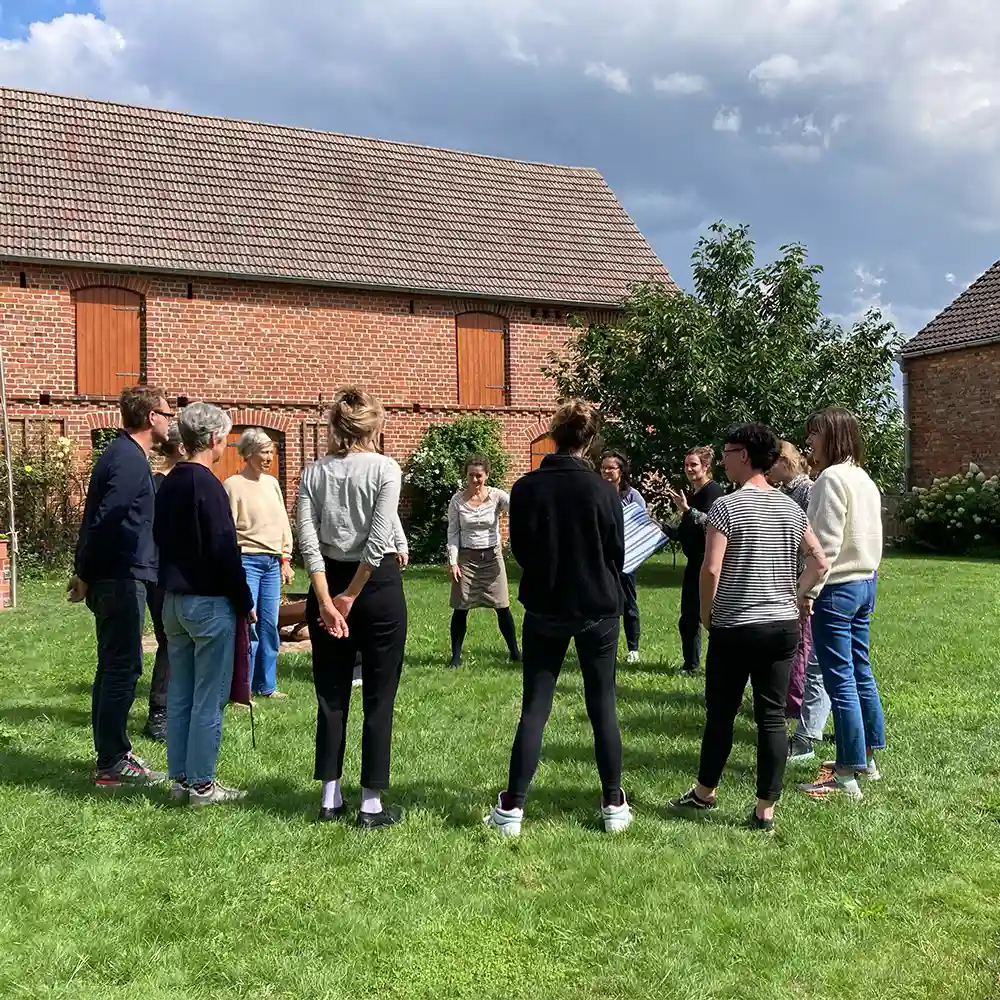
Under the pressure of change, we often fall back on familiar responses. Yet what worked in the past may not be what is needed now.
The Authentic Leadership Program creates space to pause, perceive more of what is happening, and work with real leadership challenges from different perspectives. Participants explore their own responses, the relationships around them, and the wider system — and experiment with what becomes possible when they respond differently.
Real leadership challenge
Before the retreat, participants identify a current leadership challenge. Their input helps shape the work around questions that matter to the group.
Two-day retreat
Through observation, dialogue, embodied practice, and systemic work, participants notice patterns in real time, experiment with different responses, and experience their impact directly.
Leadership experiment
Each participant translates the experience into one concrete experiment to practice in everyday leadership.
Follow-up
Facilitated peer sessions and a shared reflection support the practice phase and help participants learn from what happens back at work.
The program is grounded in Theory U, a framework for leadership and systems change developed by Otto Scharmer at MIT. At its core is the idea that the quality of our actions depends on the quality of our awareness.
A central practice in the program is Social Presencing Theater (SPT). It brings movement, spatial awareness, and interaction into the learning process. This gives participants another way of noticing what is happening in a situation — through their own responses, relationships, and the patterns that form between people.
See more before deciding
Notice what is happening before reacting, and make decisions with a fuller understanding of the people, context, and consequences involved.
Enable collaboration
Listen closely, build on what others bring, and create the conditions for trust and shared ownership.
Navigate uncertainty
Stay open to different perspectives and emerging possibilities while continuing to provide direction and take action.
Turn insight into practice
Work with a real leadership challenge, test new behaviors, and develop a practice that continues beyond the retreat.
Authentic Leadership Program | UNIQA
The program brought together leaders from different functions and countries at UNIQA to work with real leadership challenges and explore how presence, connection, and systemic awareness shape leadership and collaboration.
The two-day retreat was followed by several weeks of practice. Participants tested a concrete leadership experiment in their day-to-day work, supported by facilitated peer sessions and a shared reflection at the end.
"The retreat helped me gain clarity about where I stand and the kind of leader I want to be. I left with a clearer sense of direction and concrete next steps for my leadership practice."
I work with the knowledge, experience, and real challenges participants bring into the room.
I work with the knowledge, experience, and real challenges participants bring into the room. A clear and respectful setting allows different perspectives to be heard, patterns to become visible, and new responses to be explored.
My approach combines facilitation and coaching with reflection, dialogue, and experiential and embodied practices. I stay attentive to what happens in the room while keeping the agreed objectives in view.
Trusted by organizations
I have supported
In a free initial conversation, we can explore how the Authentic Leadership Program could fit your organization and your goals.

For more than ten years, I have worked with leaders, teams, and organizations through change — in Germany and internationally.
A question that has accompanied me throughout my work is: What creates the conditions for meaningful collaboration and lasting results?
I believe leadership is shaped not only by what we do, but also by how we perceive a situation, how we relate to others, and the place from which we act. This is at the heart of my work with leaders.
I work in English, German, and Spanish.
The program is for leaders who are dealing with change and questions that do not have an obvious answer. They may be leading teams, working across functions or countries, or trying to give direction while the situation itself is still changing.
Every program starts with a conversation about what is happening in your organization and what you want the program to achieve. This shapes the focus of the retreat.
Participants also bring a current leadership challenge of their own, so the work is connected to situations they are actually dealing with.
Before the retreat, participants identify a current leadership challenge. During the retreat, they explore that challenge from different perspectives and develop a concrete leadership experiment. Afterwards, they test it in their day-to-day work and reflect on their experience in facilitated peer sessions and a final follow-up.
Participants bring questions from their own leadership practice. These might involve a difficult decision, collaboration across teams or functions, a change in roles or responsibilities, tensions within a team, or a situation where familiar approaches are no longer working.
Embodied practice is an important part of the program. I mainly work with Social Presencing Theater (SPT), a practice within Theory U that uses movement, space, and perception to make patterns in leadership and collaboration visible.
It is not about physical performance. No previous experience is needed, and the work takes place in a safe setting that respects personal boundaries.
Each participant leaves the retreat with one concrete leadership experiment to try in their day-to-day work. During the practice period, a facilitated peer session offers space to reflect on what happens, learn from each other, and adapt the experiment. A final session brings the group back together to reflect on what they have learned and what they want to continue in their leadership practice.
The program works with groups of up to 25 participants. For the two-day retreat, I recommend a place away from the usual work environment, where the group can focus without the interruptions of everyday work. Quiet places with access to nature work particularly well.
Would you like to explore how the Authentic Leadership Program could work for your organization?
In a free initial conversation, we can look at your goals and what would make the program relevant for your leaders.